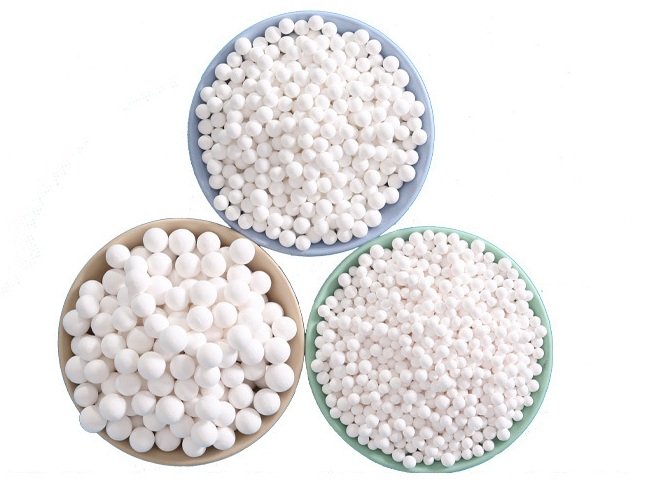
alumina balls used as activated alumina
January 29, 2024 - Reading time: 7 minutes
Alumina balls are effective at adsorbing metals like arsenic and fluoride from polluted water sources, while remaining non-toxic, odorless, and water insoluble. Acid, alkali, salt and organic solvent corrosion is easily prevented while their uniform ball size helps maximize pressure drop minimization for efficient gas dehydration, while their tailored pore distribution offers superior dynamic H2O absorption capacity.
Drying Gases
Activated alumina is used for extracting moisture from gases to avoid undesirable side effects like ice formation, liquid formation, catalyst contamination and corrosion. Commonly produced as beads with an agglomerator, pin mixer or disc pelletizer, its physical and chemical properties can be customized based on its final application - air dryers, chemical production or natural gas production all rely heavily on its ability to remove water vaporous gases efficiently and safely.
Alumina is an inert material, free from odor, non-toxic, and water soluble, making it the perfect material to act as an absorbent or desiccant in applications such as drying compressed air. Reusing this substance saves money over time as its activation and absorption capabilities can often be refreshed simply by heating in an oven again.
Alumina can adsorb moisture effectively, as well as having numerous other uses across industries like oil, coal and gas. Alumina is commonly employed for manufacturing hydrogen peroxide and polyethylene production as well as oil filtration purposes and to lower fluoride and arsenic levels in groundwater supplies.
Alumina desiccant can be used to effectively dry air and gases such as steam cracked gases, catalytic reforming recycle gases, synthesis gas, methyl chloride and natural gas due to its high absorption capacity and uniform pore distribution. Furthermore, its crush strength makes loading desiccant towers easy while its water slugging resistance prevents outlet valve and filter chocking.
Reusability makes alumina desiccant an excellent choice for air dryers and other desiccant systems, including desiccant towers. Regenerating it is straightforward, providing a low dew point even under high ambient humidity conditions; safe handling with no swelling or softening caused by liquid, and it has excellent thermal shock, abrasion resistance. Furthermore, its low attrition rate helps minimize dusting without frequent agitation needs.
Cleaning Environments
Activated alumina is an ideal material for cleaning environments as its unique porous structure makes it much more effective than silica gel or molecular sieve at absorbing water. Furthermore, its high crush strength makes it suitable for high-pressure applications; and its capacity to adsorb volatile chemicals such as sulfur dioxide, benzene, acetone, and chloride makes it an invaluable addition.
Activated alumina differs from sponges in that it actually bonds with chemicals; this process, known as adsorption, occurs over a wide variety of pH levels and temperature conditions. Furthermore, due to its pores' size and shape, activated alumina's large surface area can separate molecules efficiently, helping it remove degradation acids from transformer oils, lubricating oils, and refrigerants.
Due to its ability to bind contaminants, activated alumina is also highly useful in cleaning up environmental disasters. Its binding capabilities make it effective at cleaning up toxic waste spills as well as polluted rainwater flow, where rainwater may pick up contaminants such as arsenic and lead from mining operations, with no chance of them leeching back into the environment after cleanup has taken place.
Although activated alumina has many applications, it is crucial to gain an understanding of its workings before undertaking any projects involving its use. Recognizing that regular regeneration may be required if exposed to extreme temperatures or humidity conditions is essential. Improper regeneration can damage or degrade alumina, significantly decreasing its capacity and lifespan. Therefore, it is crucial that appropriate regeneration methods be chosen based on the specific contaminants adsorbing onto it as well as following best practices when conducting this process. Before purchasing and using activated alumina, it is vital to conduct compatibility tests in order to ensure its safe and efficient use. Furthermore, to prevent contamination or any adverse reactions when handling activated alumina it is advisable to wear appropriate PPE such as safety goggles, gloves and face mask or respirators when handling.
Catalysts
Activated alumina has many uses in industrial settings, from desiccant applications to general purpose applications. As it is composed of aluminum hydroxide shaped into hard, small spheres tunneled at microscopic levels with an increased surface area - activated alumina can absorb moisture molecules that land on its surface to act as an effective desiccant.
Alumina spheres boast high crush resistance, resist chemical attack and thermal shock, making them an excellent choice for industrial and chemical settings. Their characteristics make them well-suited to packaging and drying chemical products as well as using as moisture absorbents during shipment; making them the perfect option for pharmaceutical, hydrogen peroxide plant and water purification industries.
Activated alumina can also be an invaluable asset when cleaning up toxic waste sites and mining mishaps that have polluted rainwater streams with arsenic or fluoride contamination, rendering these waters unsafe to drink. By bonding to contaminants like these substances, activated alumina is an ideal way of mopping up any contamination before it seeps further into groundwater supplies and keeping our drinking supplies safe for human consumption.
Activated alumina has the ability to defluorinate drinking water in some countries, which has become an increasing problem. With an impressive 6400 grams per cubic meter adsorption capacity and multiple micropaths and large surface areas for polar molecule absorption, activated alumina serves as an effective deep desiccant or catalyst carrier; its attachment force for water, oxide, acetic acid and alkali molecules is very strong.
Active Alumina can also be utilized as a catalyst in the production of ethylene and polyethylene polymers. As an efficient catalyst, it reduces lead, tin, and chromium usage for manufacturing these polymers - helping manufacturers both lower environmental impact and save costs simultaneously. Furthermore, its hydrogenation activity helps lower emissions levels as well as carbon dioxide concentration levels significantly.
Defluorination
Fluoride levels that exceed safe limits in drinking water can be reduced by passing it through a bed of activated alumina, which absorbs fluoride molecules before dispersing them, helping keep excess fluoride from harming people.
large surface area of activated alumina and many pores make it the ideal material to defluorination processes. While sponge absorbs fluoride molecules quickly, activated alumina actually bonds with them allowing it to remove large quantities from water in short amounts of time.
The activation process involves heating aluminum oxide to high temperatures before grinding it to form a fine powder, which is then granulated and passed through an activated carbon filter to filter out impurities before being packed for use in industrial and residential water treatment facilities.
Our alumina balls can also serve as desiccants and purifiers for chemicals like propylene, butane, LPG, carbon dioxide and chlorofluoro hydrocarbons. Their high humidity-drying efficiency also makes them useful in removing lead, arsenic and fluoride from wastewater streams and water supplies for commercial, industrial and home uses.
Alumina can also be used in the reconditioning of insulating oil, circuit breaker oil, and transformer oils. Over time these types of oils produce acid which damages mechanical parts; using alumina as part of their treatment can lower their acid number significantly while prolonging equipment lifespan.
Regenerating activated alumina is an easy process. Combine 10 liters of water with 1 percent caustic soda (NaOH). Stir this solution until all the alumina has dissolven, before adding any granulated material from prior batches to your bucket. Secure the nylon bag around these granules before leaving them soaking for 8 hours to be ready for its next application.
Once an alumina has reached its capacity, it should be regenerated regularly to prevent untreated fluoride from polluting the environment. A monitoring schedule based on treated water gallons should be developed in order to keep this device performing at maximum capacity.